Debug
Debugger User Interface
Many features of the CMSIS Debugger extension are exposed in the Run and Debug view of VS Code.
- Start debugging selects a configuration: launch to start download/debug, attach to connect with a running system.
- Debug Toolbar has buttons for the most common debugging actions that control execution.
- The Trace and Live View shows the LIVE WATCH window.
- Debug Statusbar shows the time spent running the application.
- The Debug Console can be used to interact with the debugger on the command line.
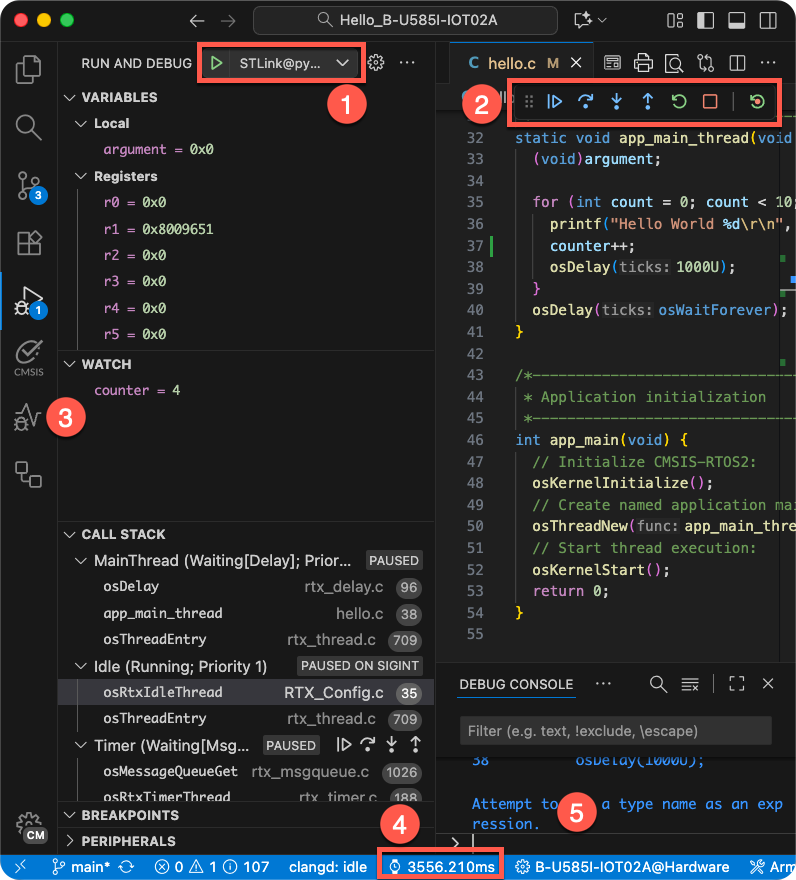
Most editor features are available during debugging. For example, developers can use Find and edit source code to correct program errors.
The Run and Debug view provides:
- VARIABLES section, which includes local function variables and CPU register values.
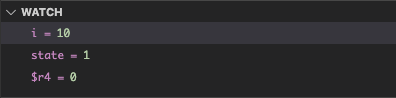
- WATCH section, which allows viewing user-defined expressions, for example, variable values.
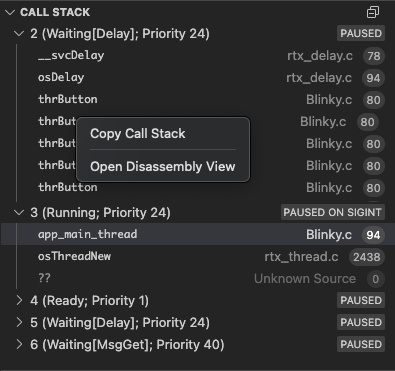
- CALL STACK section that shows active RTOS threads along with the call stack.
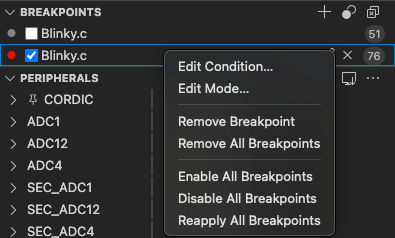
- BREAKPOINTS section for managing stop points in application execution to inspect the state.
📌 TIP
Click on a line number badge to navigate to the source code line.
Other debugger specific views or features:
- CPU Time shows execution timing and statistics of the past five breakpoints.
- Live Watch offers run-time viewing of user-defined expressions, for example, variable values.
- Component Viewer shows detailed information to help analyze the operation of software components.
- Core Peripherals view gives insight into the programming of CPU specific core peripherals.
- Peripherals show the device peripheral registers and allow changing their values.
- Memory Inspector provides a powerful and configurable memory viewer.
- Disassembly shows assembly instructions and supports run control, for example with stepping and breakpoints.
- Debug Console lists debug output messages and allows entering expressions or GDB commands.
- Serial Monitor uses serial or TCP communication to interact with application I/O functions
(
printf,getc, etc.). - Multi-Core Debug to view and control several processors in a device.
Target interaction while running
Depending on the debug view and the debug probe used, target interaction with a Cortex-M CPU may or may not possible while running. The following table shows target interaction capabilities while running (with J-Link GDB server or using pyOCD):
| View | Read | Edit |
|---|---|---|
| Memory Inspector | ✅ | ✅ |
| Peripherals | ✅ | ✅ |
| Live Watch | ✅ | ❌ |
| Component Viewer | ✅ | ❌ |
| Core Peripherals | ✅ | ❌ |
| VARIABLES | ❌ | ❌ |
| WATCH | ❌ | ❌ |
| CALL STACK | ❌ | ❌ |
Number formats
Expressions can be represented in different number formats. The debuggers default format is natural. If you wish to
change the radix, there are multiple ways to do so:
- To change it globally, right-click for example in an editor window and select Set Global Output Radix to ....
This allows you to switch the global radix between
decimalandhexadecimal. - To change the radix of a single expression, you can edit it for example in the
Live Watch or WATCH view. Then, add a "
," to the expression, directly followed by one of these format specifiers (make sure no space is between the,and the format specifier):
| Specifier | Format |
|---|---|
x |
hexadecimal |
d |
decimal |
o |
octal |
t or b |
binary |
z |
zero-hexadecimal (includes leading zeros) |
- You can also use this syntax in the DEBUG CONSOLE.
Examples
counter,d
value,o
number,t
Debug toolbar
During debugging, the Debug toolbar contains actions to control the flow of the debug session, such as stepping through code, pausing execution, and stopping the debug session.
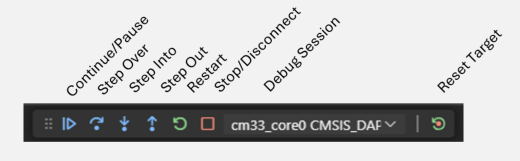
| Action | Description |
|---|---|
| Continue/Pause | Continue: Resume normal program execution (up to the next breakpoint). Pause: Inspect code executing at the current location. |
| Step Over | Execute the next statement as a single command without inspecting or following its component steps. |
| Step Into | Enter the next statement to follow its execution line-by-line. |
| Step Out | When inside a function, return to the earlier execution context by completing remaining lines of the current method as though it were a single command. |
| Restart | Terminate the current program execution and start debugging again using the current run configuration. |
| Stop/Disconnect | Stop: Terminate the current debug session. Disconnect: Detach debugger from a core without changing the execution status (running/pause). |
| Debug Session | For multi-core devices, the list of active debug sessions and switch between them. |
| Reset Target | Reset the target device. |
VARIABLES
During debugging, you can inspect variables, expressions, and registers in the VARIABLES section of the Run and Debug view or by hovering over a variable or expression in the source code editor. Variable values and expressions are evaluated in the context of the selected stack frame in the CALL STACK section. In the case of multi-core, the content is relative to the active debug session.
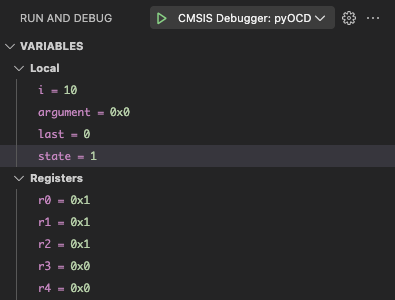
To change the value of a variable during the debugging session, right-click on the variable in the VARIABLES section and select Set Value.
You can use the Copy Value action to copy the variable's value, or the Copy as Expression action to copy an expression to access the variable. You can then use this expression in the WATCH section.
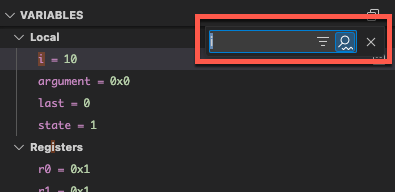
To filter variables by their name or value, use the Alt/Opt + Ctrl/Cmd + F keyboard shortcut while the focus is on the VARIABLES section, and type a search term.
WATCH
Variables and expressions can also be evaluated and watched in the WATCH section. You can use the Copy Value action to copy the variable's value, or the Copy as Expression action to copy an expression to access the variable. You can then use this expression in the WATCH section.
CALL STACK
The CALL STACK section shows the function call tree that is currently on the stack. Threads are shown for applications that use an RTOS. Each function call is associated to its location and when source code is available a line number badge is shown. A click on this badge navigates to source file location.
The window content is updated whenever program execution stops.
BREAKPOINTS
A breakpoint pauses the code execution at a specific point, so you can inspect the state of your application at that point. There are several breakpoint types.
Setting breakpoints
To set or unset a breakpoint, click on the editor margin or use F9 on the current line.
- Breakpoints in the editor margin are normally shown as red-filled circles.
- Disabled breakpoints have a filled grey circle.
- When a debugging session starts, breakpoints that can't be registered with the debugger change to a grey hollow circle. The same might happen if the source is edited while a debug session without live-edit support is running.
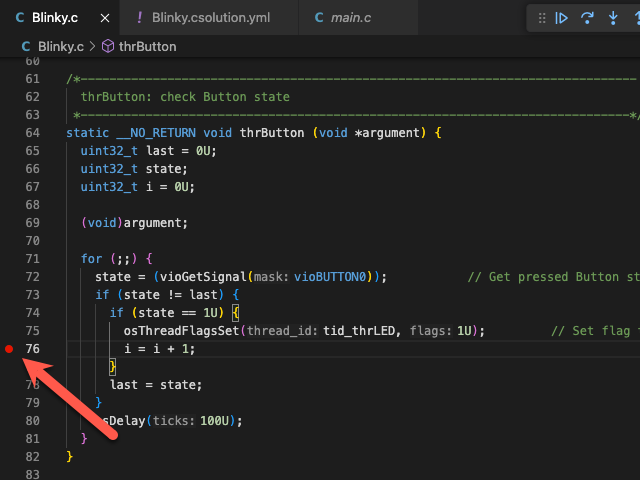
For more control of breakpoints, use the BREAKPOINTS section that lists and manages all breakpoints.
📝 Note:
You can set breakpoints anytime during your debug session. However, when setting a breakpoint while running an application, the target stops for a short period of time.
Breakpoint types
Apart from the code breakpoint, there are other breakpoint types to satisfy specific use cases.
Function breakpoints
Instead of placing breakpoints directly in source code, a debugger can support creating breakpoints by specifying a function name. This is useful in situations where the source is not available but a function name is known.
To create a function breakpoint, select the + button in the BREAKPOINTS section header and enter the function name. Function breakpoints are shown with a red triangle in the BREAKPOINTS section.
Conditional breakpoints
Set breakpoint conditions based on expressions, hit counts, or a combination of both.
- Expression condition: The breakpoint is hit whenever the expression evaluates to true.
- Hit count: The hit count controls how many times a breakpoint needs to be hit before it interrupts execution.
- Wait for breakpoint: The breakpoint is activated when another breakpoint is hit (triggered breakpoint).
To add a conditional breakpoint:
-
Create a conditional breakpoint
- Right-click in the editor margin and select Add Conditional Breakpoint.
- Use the Add Conditional Breakpoint command in the Command Palette (⇧⌘P).
-
Choose the type of condition you want to set (expression, hit count, or wait for a breakpoint).
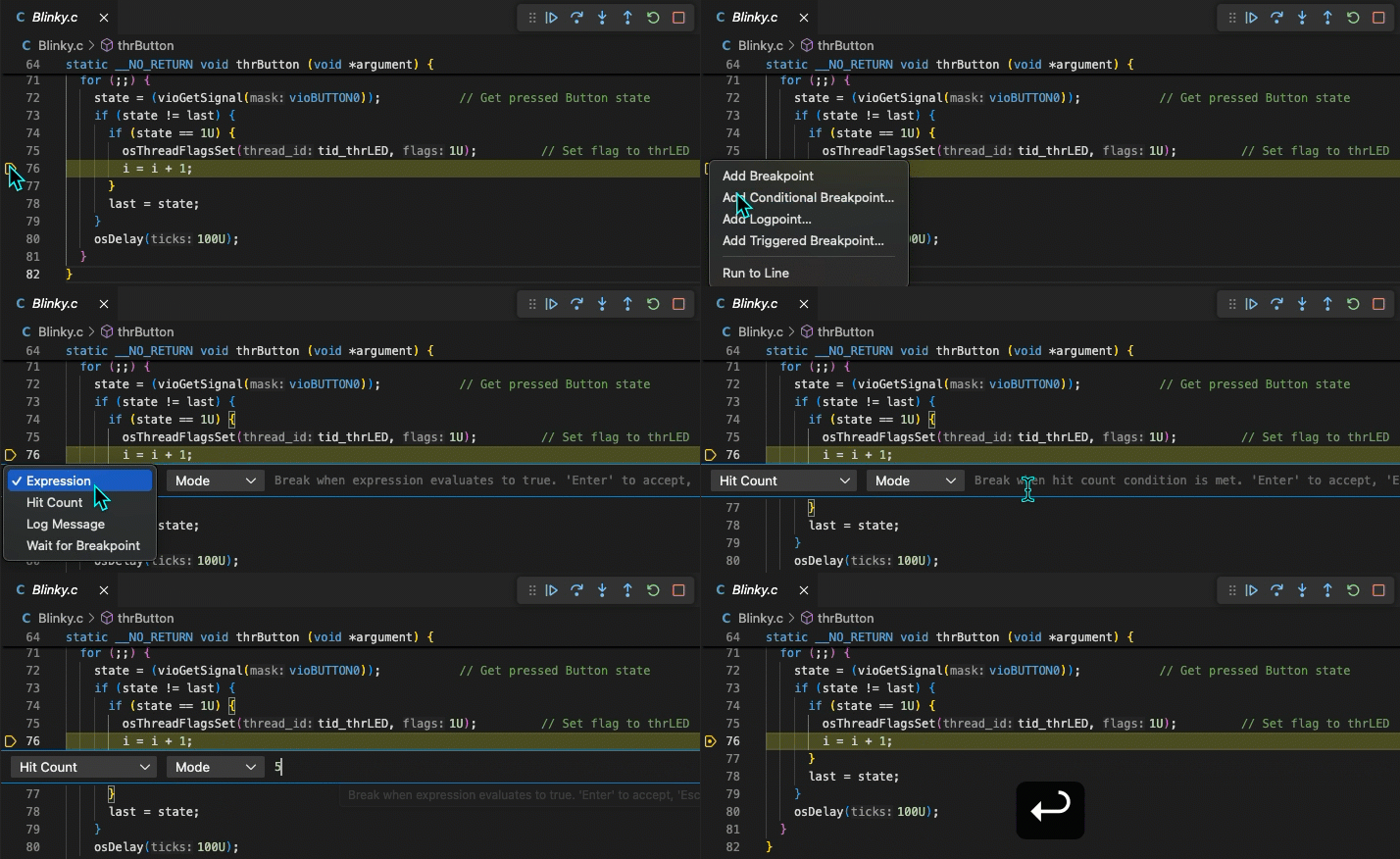
To add a condition to an existing breakpoint:
-
Edit an existing breakpoint
- Right-click on the breakpoint in the editor margin and select Edit Breakpoint.
- Select the pencil icon next for an existing breakpoint in the BREAKPOINTS section of the Run and Debug view.
-
Edit the condition (expression, hit count, or wait for breakpoint).
📝 Note:
For checking the the breakpoint condition, the target is halted for a short period of time.
Data breakpoints
Data breakpoints can be set from the context menu of a variable in the WATCH section. The Break on Value Change/Read/Access commands add a data breakpoint that is hit when the value of the underlying variable changes/is read/is accessed. Data breakpoints are shown with a red hexagon in the BREAKPOINTS section and the type of breakpoint is shown (Write/Read/Access).
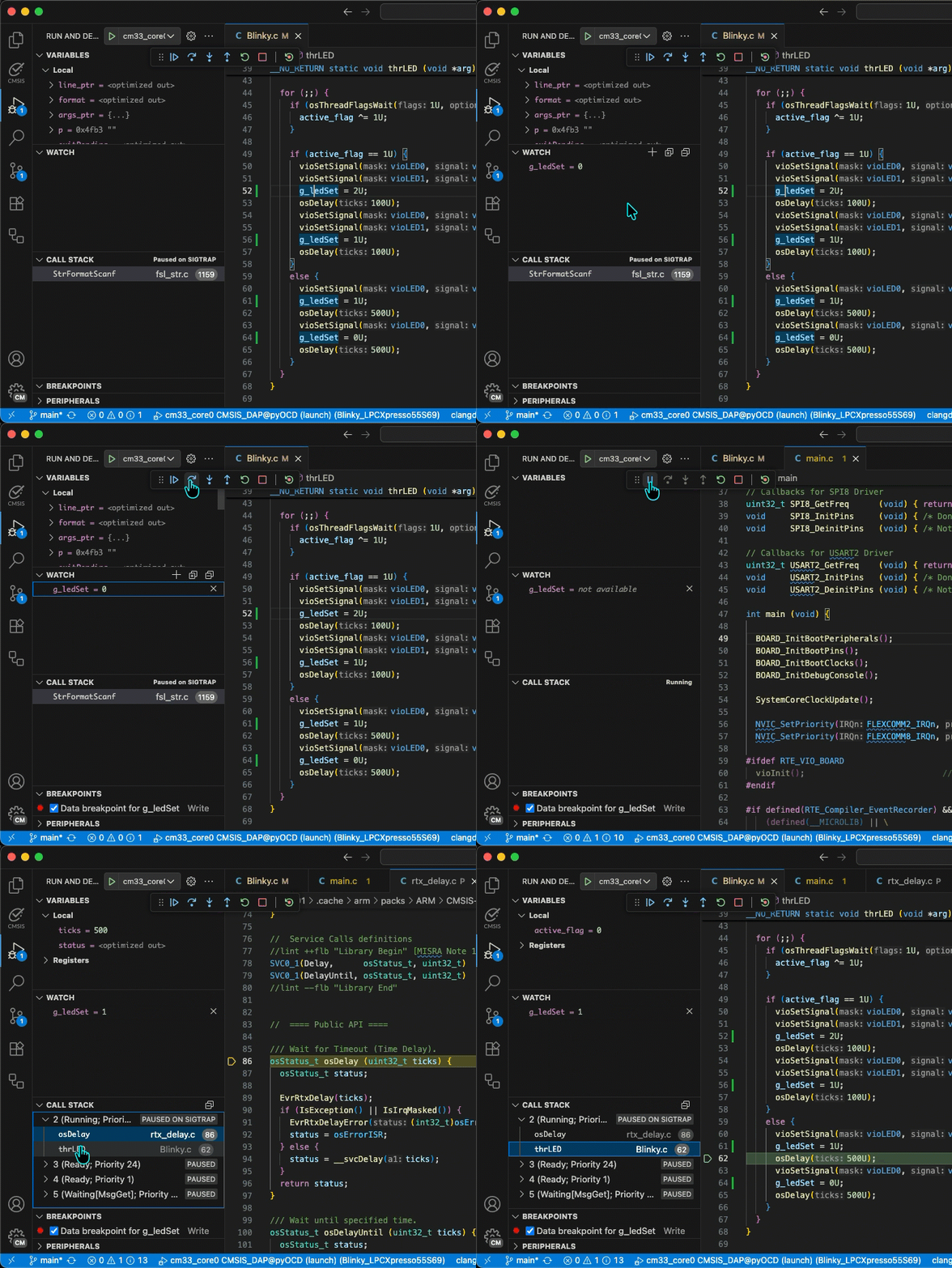
📝 Note:
When hitting a data breakpoint, the program execution does not stop exactly on that line of code. Depending on the underlying CPU architecture, stopping can be delayed by up to 5 cycles. Use the Call Stack view to determine what caused the execution to stop.
Triggered breakpoints
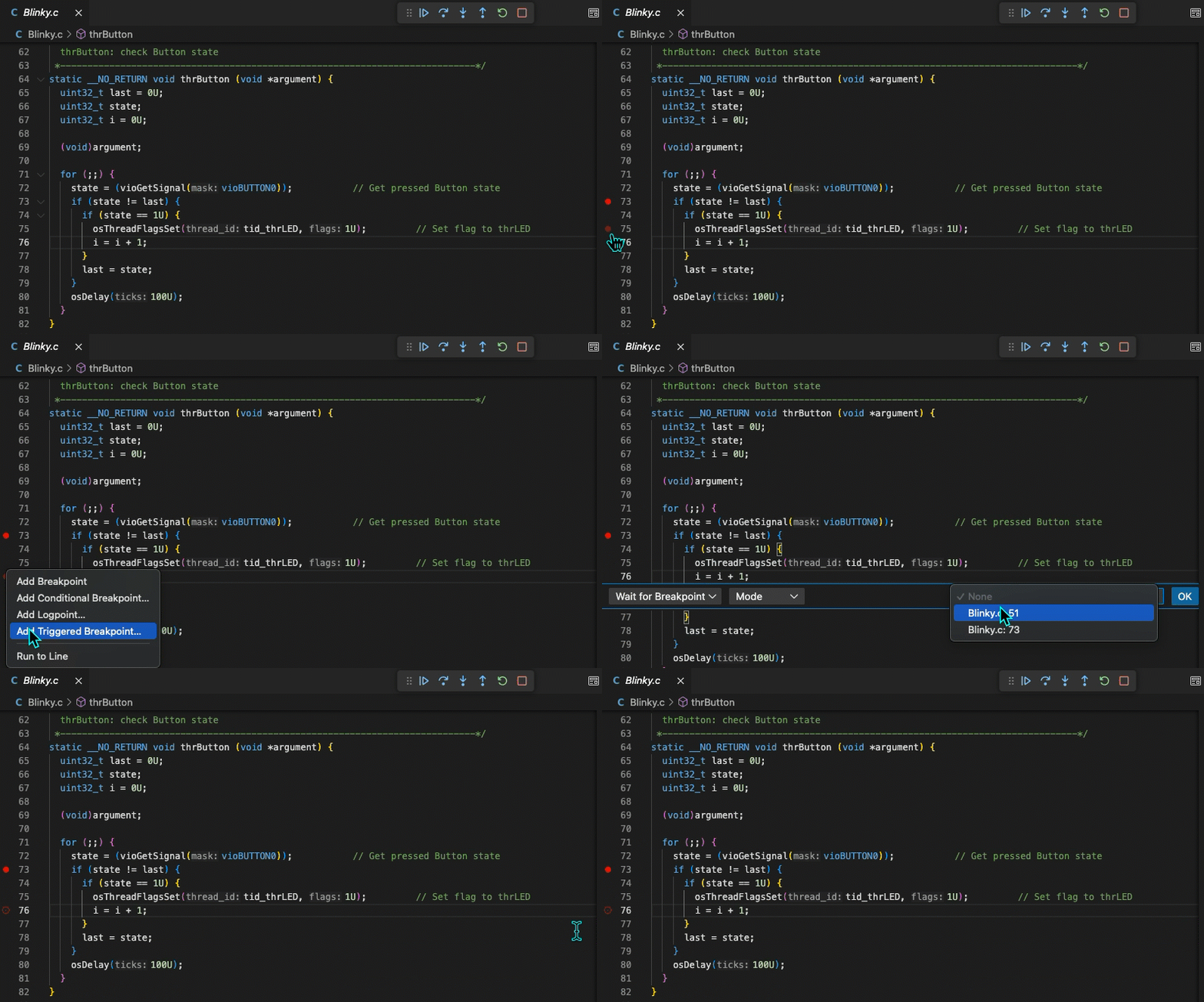
A triggered breakpoint is type of conditional breakpoint that is enabled once another breakpoint is hit. They can be useful when diagnosing failure cases in code that happen only after a certain precondition.
Triggered breakpoints can be set by right-clicking on the glyph margin, selecting Add Triggered Breakpoint, and then, choose which other breakpoint enables the breakpoint.
Logpoints
A logpoint pauses the program execution for a short period of time, sends a message to the debug console, and then continues with the application. Logpoints can help you save time by not having to add or remove logging statements in your code.
A logpoint is represented by a diamond-shaped icon. Log messages are plain text, but can also include expressions to be
evaluated within curly braces ({}).
To add a logpoint, right-click in the editor left margin and select Add Logpoint, or use the Debug: Add Logpoint... command in the Command Palette (Ctrl/Cmd + Shift + p).
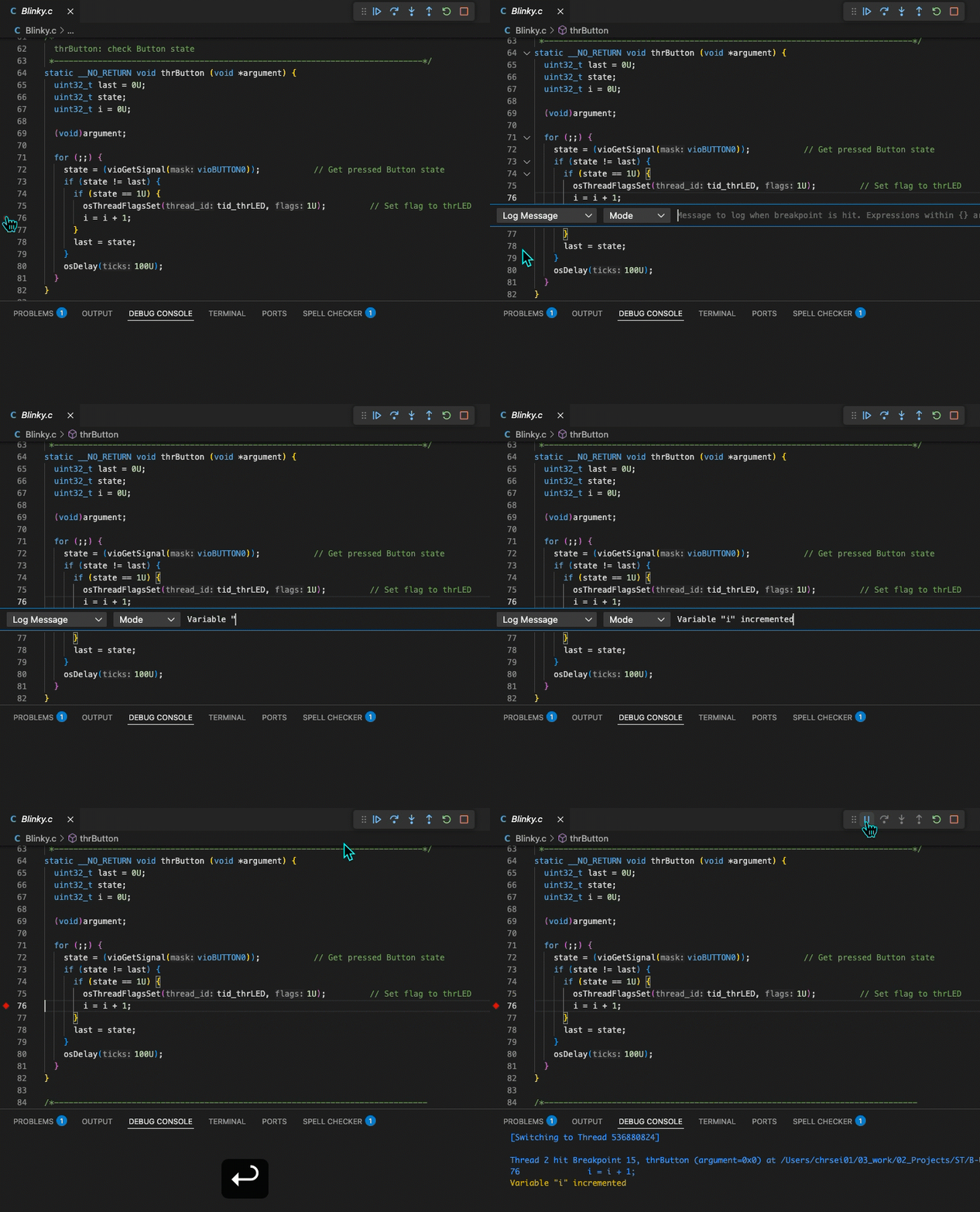
Just like regular breakpoints, logpoints can be enabled or disabled and can also be controlled by a condition and/or hit count.
CPU Time
Most Arm Cortex-M processors (except Cortex-M0/M0+/M23) include a DWT->CYCCNT register that counts CPU states. In combination with the CMSIS variable SystemCoreClock the CMSIS Debugger calculates execution time and displays it along with the selected processor core in the CPU Time Status bar. A click on the CPU Time Status bar opens the related VS Code command palette.
| Command | Description |
|---|---|
| CPU Time | Print CPU execution time and history of past program stops. |
| Reset CPU Time | Reset CPU execution time and history. Set new reference time (zero point). |
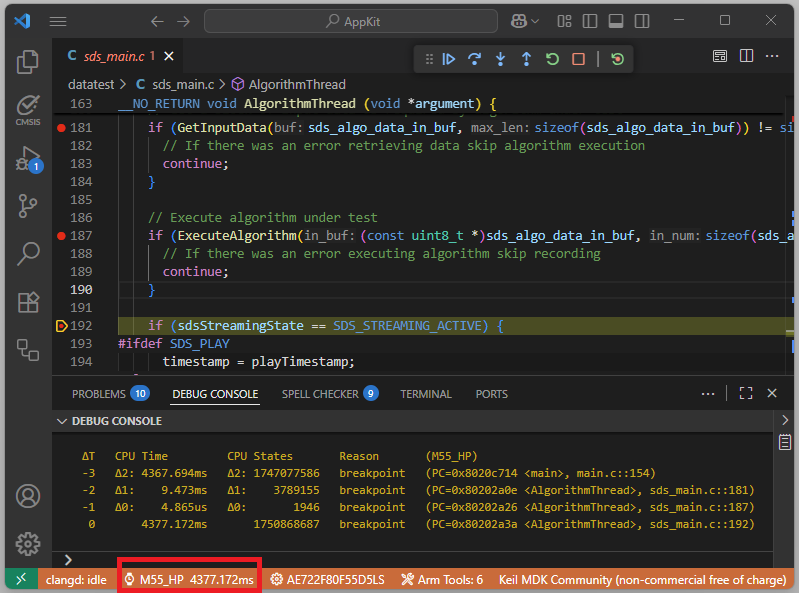
📝 Notes:
- The first program stop (typically at function
main) is the initial reference time (zero point).DWT->CYCCNTis a 32-bit register incremented withSystemCoreClockfrequency. The time calculation copes with one overflow between program stops. Multiple overflows between program stops deliver wrong time information.- Each processor in a multi-processor system has and independent
DWT->CYCCNTregister.
Trace and Live view
The Trace and Live View
 (available from the VS Code Activity Bar) currently contains the LIVE WATCH, the
COMPONENT VIEWER, and the CORE PERIPHERALS views.
(available from the VS Code Activity Bar) currently contains the LIVE WATCH, the
COMPONENT VIEWER, and the CORE PERIPHERALS views.
The CMSIS Debugger stores dynamic view state per debug configuration in the vscode-cmsis-debugger.viewState VS Code workspace setting. The stored state includes view-specific configurations, e.g. the last filter text and periodic update options for the COMPONENT VIEWER, and the enabled/disabled state of the CPU Time display.
When you start the same debug configuration again, its previous state is restored automatically. To clear the stored state, run the CMSIS Debugger: Reset All Dynamic View States command from the Command Palette.
LIVE WATCH
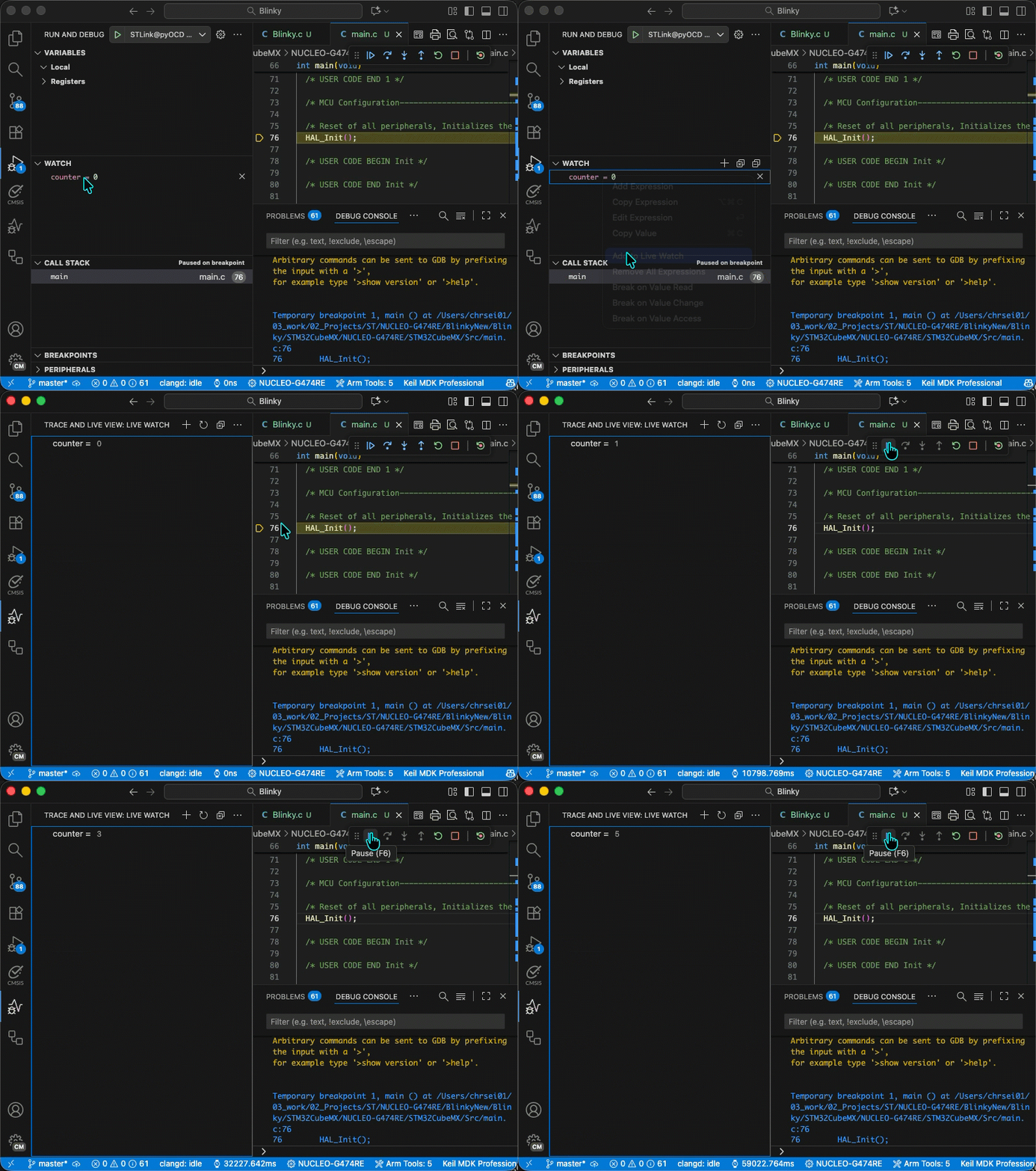
You can add expressions to this view that are updated while the application is running on your target by:
- Pressing the
+sign and entering an expression. - Using the context menu item Add to Live Watch in the editor or the the Run and Debug view.
COMPONENT VIEWER
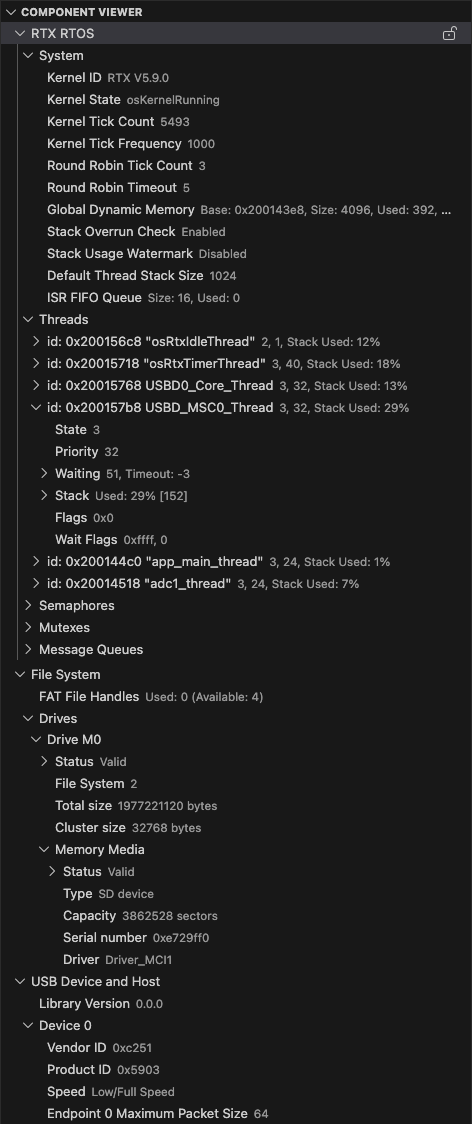
This view shows detailed information to help analyze the operation of software components. The required infrastructure can be easily added to user applications.
Refer to the Component Viewer documentation for detailed advice on how to show information from user software using an SCVD file.
The Component Viewer shows information about:
- Information from software components that is provided in memory for example by static variables or structures.
- Objects that are addressed by handles or dynamic arrays.
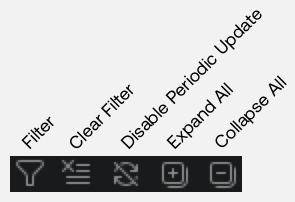
The Component Viewer toolbar offers the following action buttons:
| Button | Description |
|---|---|
| Filter | Filter the displayed components and their entries |
| Clear Filter | Remove component filtering |
| Disable Periodic Update | Components are not updated while the target is running |
| Expand All | Show all components at once |
| Collapse All | Only show top-level component name |
The Disable Periodic Update button stops updates for all components. If you wish to lock a single component, use
the component's  button to disable periodic updates.
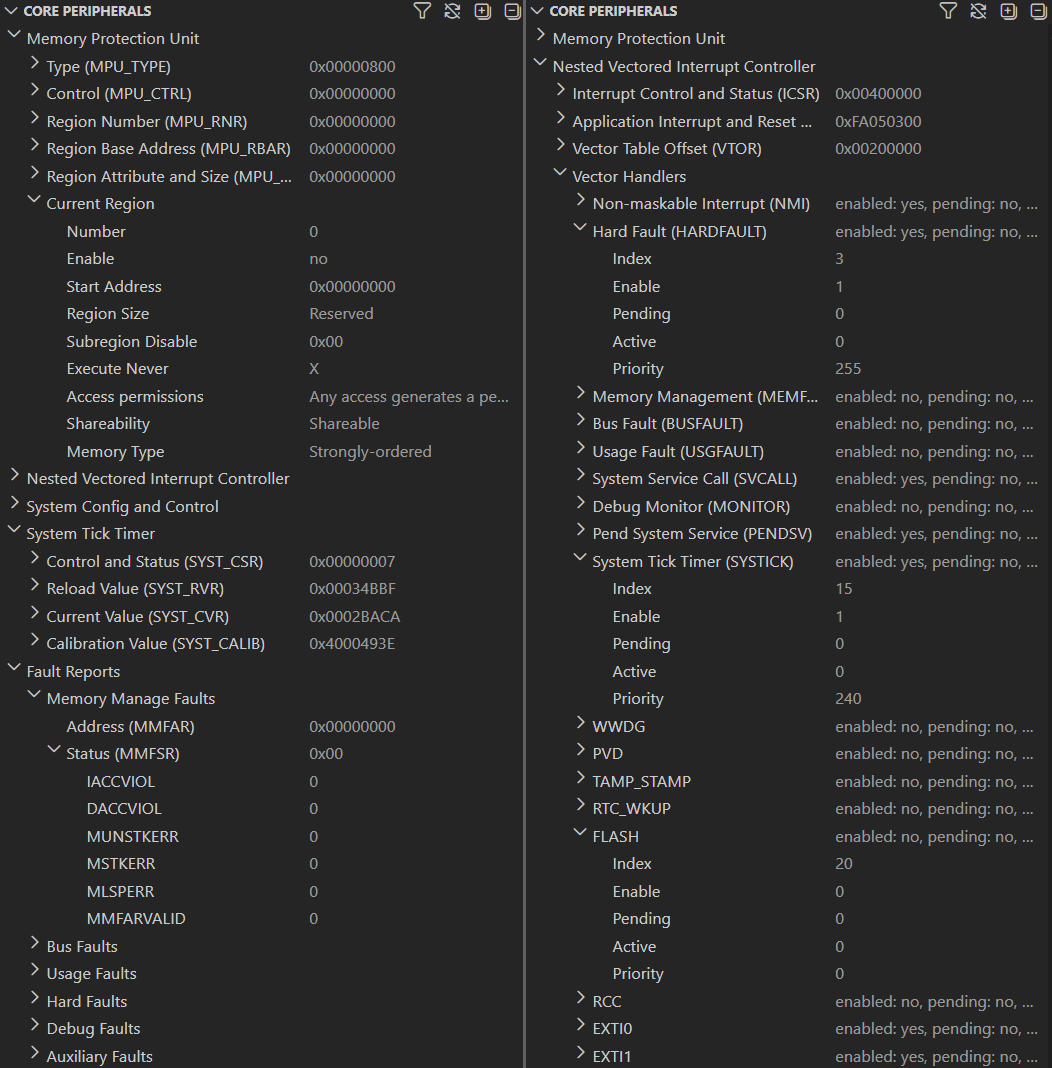
CORE PERIPHERALS
The CORE PERIPHERALS view gives insight into the programming of CPU specific core peripherals.
The Core Peripherals view shows information about the following components if implemented by the CPU:
- Memory Protection Unit
- Nested Vectored Interrupt Controller
- System Config and Control
- System Tick Timer
- Fault Reports
Trace Generation
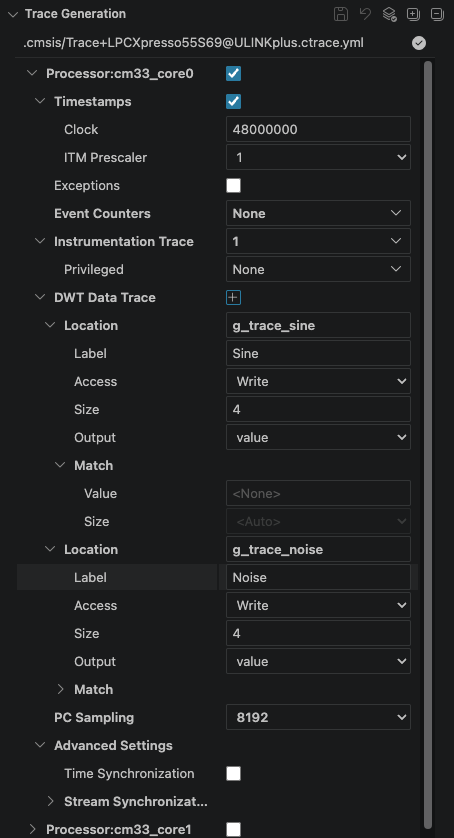
CMSIS Debugger supports capturing trace information from Cortex-M processors using Serial Wire Output (SWO). You can configure which trace information the processor generates, capture the resulting trace without stopping program execution, and inspect the decoded trace data directly in Visual Studio Code.
In the debug toolbar, use the
 button to open the generated
 .csv trace file in the Trace Data view.
For further details on how to configure and inspect trace, refer to Using trace.
PERIPHERALS
The PERIPHERALS view shows the device peripheral registers and allows to change their values. It uses the CMSIS-SVD files that are provided by silicon vendors and distributed as part of the CMSIS Device Family Packs (DFP).
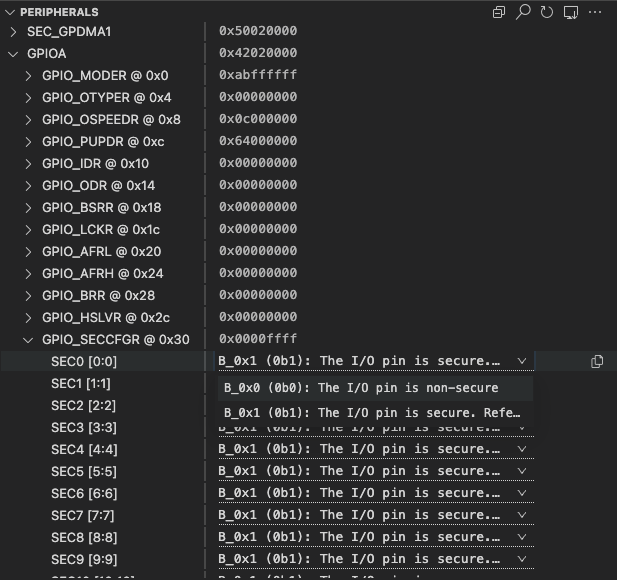
For more information, refer to the Peripheral Inspector GitHub repository.
Memory Inspector
The Memory Inspector provides a powerful and configurable memory viewer that features:
- Configurable Memory Display: Shows memory data with various display options.
- Address Navigation: Easily jump to and scroll through memory addresses.
- Variable Highlights: Colors memory ranges for variables.
- Multiple Memory Formats: Shows memory data on hover in multiple formats.
- Edit Memory: Allows in-place memory editing if the debug adapter supports the WriteMemoryRequest.
- Memory Management: Enables saving and restoring memory data for specific address ranges (Intel Hex format).
- Customized Views: Create and customize as many memory views as you need.
- Lock Views: Keep views static, unaffected by updates from the debug session.
- Periodic Refresh: Automatically refresh the memory data.
- Multiple Debug Sessions: Switch between multiple debug sessions using a dropdown in the memory view.
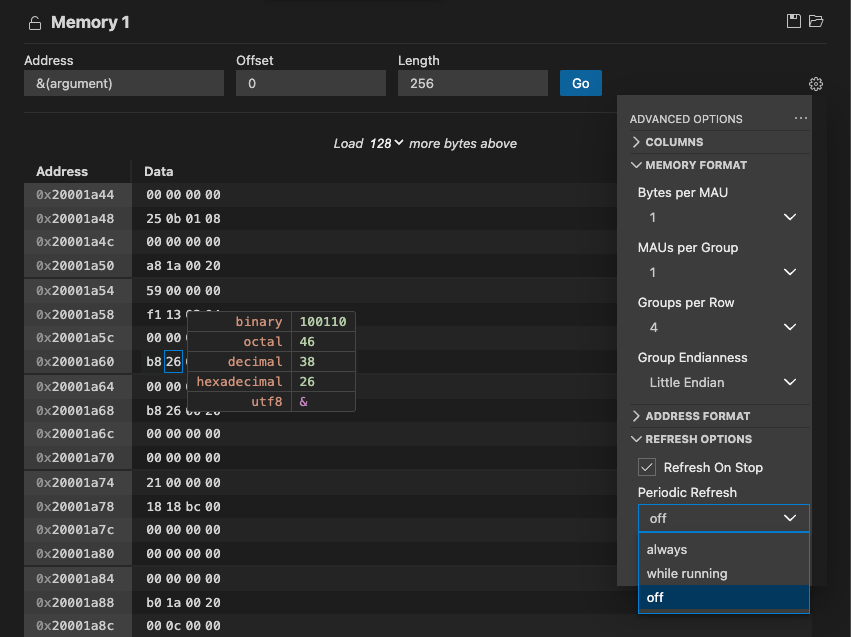
For more information, refer to the Memory Inspector GitHub repository.
Disassembly
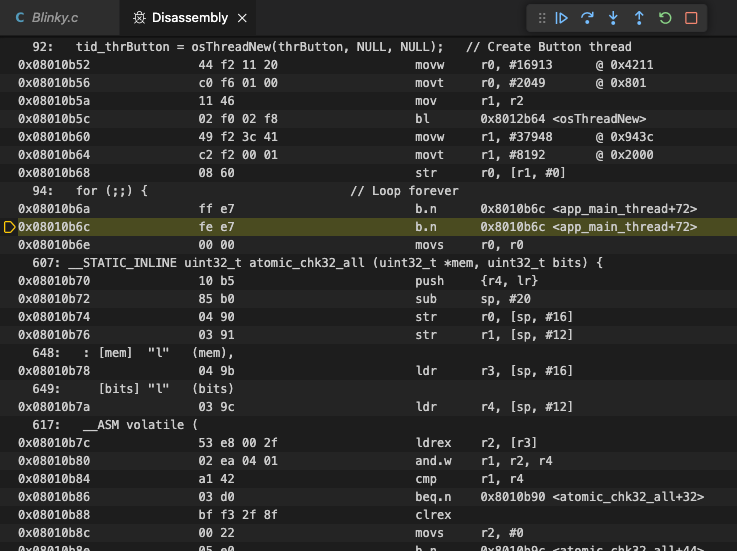
The command Open Disassembly View (available from command palette or context menus) shows the assembler instructions of the program intermixed with the source code. Using this view allows single stepping or managing breakpoints at the CPU instruction level.
📝 Note:
- Enable the VS Code setting Features > Debug > Disassembly View: Show Source Code to show assembler instructions interleaved with source code.
RTOS Views
For RTOS awareness, the RTOS Views extension needs to be added to VS Code. This extension supports a wide range of real-time operating systems, such as FreeRTOS, Zephyr, embOS,and Keil RTX5.

📝 Note:
- This is not a live view. It only gets updated when the program execution is stopped.
- To enable the view, you need to go to the debug view and press Ctrl/Cmd - Shift - P. Select RTOS Views: Toggle RTOS Panel. Afterwards, start your debug session.
- The view is located in the Terminal panel at the bottom and is called XRTOS.
- If it does not show values after entering a debug session and running the application, press Ctrl/Cmd - Shift - P again and select RTOS Views: Refresh.
Debug Console
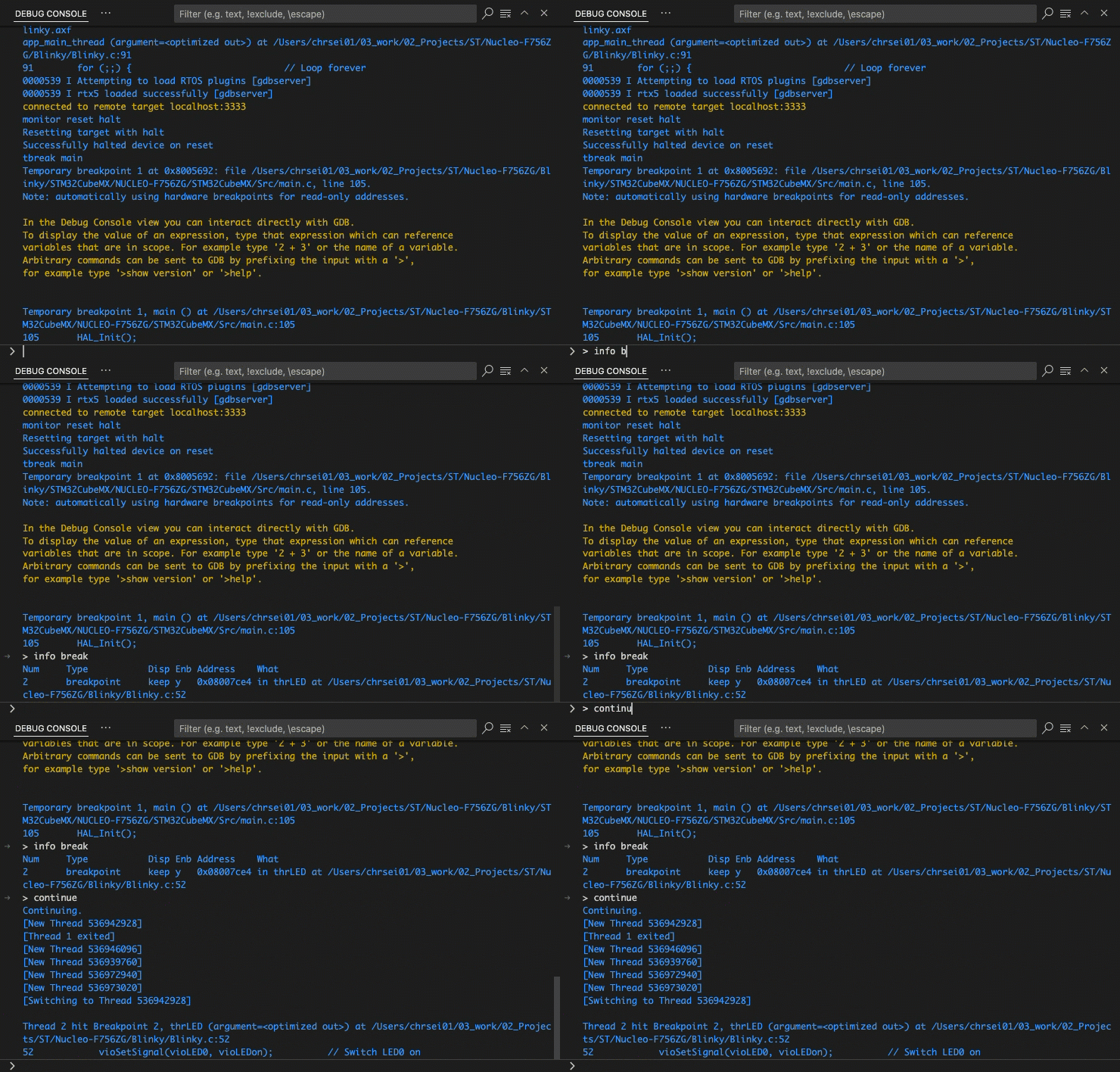
The Debug Console enables viewing and interacting with the output of your code running in the debugger. Expressions can be evaluated with the Debug Console REPL (Read-Eval-Print Loop) feature.
With the CMSIS Debug extension, you can use the Debug Console REPL to enter
GDB commands while debugging. Before entering
a GDB command, you have to explicitly enter a "greater-than"-character > so that the following strings can be
evaluated as a GDB command.
Debug Console input uses the mode of the active editor, which means that it supports syntax coloring, indentation, auto closing of quotes and other language features.
Example
The following example shows how to check the currently set breakpoints with the > info break command. Afterwards, the
application is run with the > continue command.
Serial Monitor
The Serial Monitor allows users to configure, monitor, and communicate with serial or TCP ports.
Multi-Core Debug
A GDB server provides multiple connections to the processor cores (identified with pname) of a device. The list below shows the output of pyOCD in the DEBUG CONSOLE of VS Code.
0000680 I Target device: MCXN947VDF [cbuild_run]
0001585 I core 0: Cortex-M33 r0p4, pname: cm33_core0 [cbuild_run]
0001585 I core 1: Cortex-M33 r0p4, pname: cm33_core1 [cbuild_run]
0001585 I start-pname: cm33_core0 [cbuild_run]
0001600 I Semihost server started on port 4444 (core 0) [server]
0001636 I GDB server started on port 3333 (core 0) [gdbserver]
0001641 I Semihost server started on port 4445 (core 1) [server]
0001642 I GDB server started on port 3334 (core 1) [gdbserver]
0007560 I Client connected to port 3333! [gdbserver]
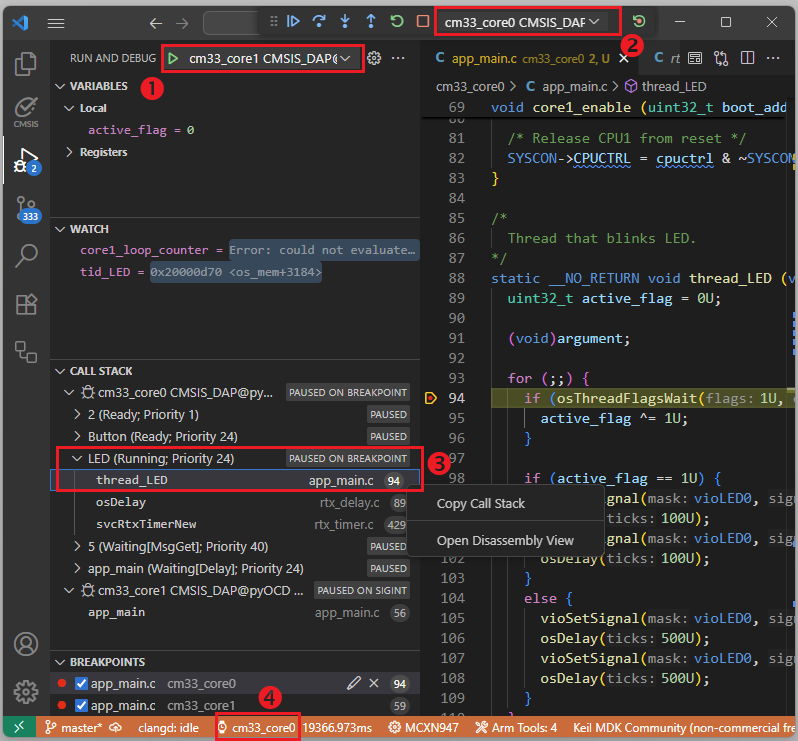
The start-pname indicates the processor that starts first and boots the system. A debug launch command connects to this processor. Use a debug attach command to connect to processors that are running. The picture below highlights the parts of the user interface that interact with processors.
- Select a processor and Start Debug. This connects the debugger.
- Select a Processor in the debug toolbar, or
- Click in CALL STACK on a thread or function name to select a processor.
- The selected processor is also shown in the CPU Time Status bar. This processor context is used in the VARIABLES and WATCH view.
📝 Notes:
- The SEGGER JLink GDB server uses a launch command to connect to a running processor whereas other GDB servers use an attach command.
- A Disassembly View opens only for a selected processor; otherwise the command is shown as disabled.
Using Trace
CMSIS Debugger supports capturing trace information from Cortex-M processors using Serial Wire Output (SWO). You can configure which trace information the processor generates, capture the resulting trace without stopping program execution, and inspect the decoded trace data directly in Visual Studio Code.
Trace configuration
Trace configuration consists of these parts:
- The CMSIS solution file (
csolution.yml) configures the trace transport and capture method, including the SWO input and output clocks. - The
./cmsis/<target>.dbgconffile configures trace pins, clocks, and other device specific trace communication components. - The Trace Generation view configures the trace sources in the processor, such as exception trace, instrumentation trace, DWT data trace, event counters, and PC sampling. The trace source configuration is stored separately in a target-specific
.cmsis/<target>.ctrace.ymlfile.
This separation allows the trace transport, such as SWO, to be configured independently from the processor trace sources that produce the data.
Configure SWO trace in the CMSIS solution
Before configuring individual trace sources, enable SWO trace for the target.
-
Select the debug adapter
- Open Manage Solution and select the debug adapter to use with the target.
- Save the solution configuration before continuing.
For example, you can use an onboard ST-Link debug adapter with pyOCD.
-
Enable SWO
From Manage Solution, select Edit csolution.yml and add a
tracesection to the debugger configuration.For example:
yaml
  debugger:
    name: ST-Link@pyOCD
    clock: 4000000
    protocol: swd
    trace:
      - swo-uart:
        mode: file
        input-clock: 84000000
        output-clock: 1500000
Key Description swo-uartSelects SWO as the trace output. mode: fileCaptures the trace to a file for subsequent analysis input-clockSpecifies the clock used by the target trace hardware. It must correspond to the actual processor or trace clock used by the application. output-clockSpecifies the SWO communication rate used to transfer trace data to the debug adapter. In the example above, the trace input clock is 84 MHz and the SWO output clock is 1.5 MHz.
⚠ Important:
The appropriate clock values depend on the target and application configuration. An incorrect
input-clockcan prevent SWO trace from being decoded correctly. Verify the processor clock used by your application.Save
csolution.yml. The Trace Generation view now shows the trace capabilities of the selected processor.
Configure trace communication in .dbgconf
Depending on the hardware target, a .cmsis/<target>.dbgconf file might exist that lets you configure the trace pin and clock
settings using Configuration Wizard view. For example, if you are switching from an off-the-shelf development board
to custom hardware, don't forget to adapt these settings.
Configure trace sources
Open the Trace And Live View and scroll down to Trace Generation.
By default, the start processor is enabled as a trace source. Select the information that you want to capture. The available options depend on the trace capabilities of the processor.
Timestamps
Enable Timestamps for timing information. Timestamps contribute to the cycle information in the decoded trace. They are normally not displayed as individual trace records.
- Clock: reserved for future use.
- ITM Prescaler: defines the granularity and hence the number of generated timestamps. A higher value reduces the generated data but also means less accurate timestamps.
Exceptions
Enable Exceptions to record exception activity.
In the decoded trace, index identifies the exception number and value identifies the exception event (0x1 - Enter Exception, 0x2 - Exit Exception, 0x3 - Return to Exception/Thread mode).
Event Counters
Enable Event Counters to include supported processor events in the trace.
Each bit in the decoded value indicates that a specific counter wrapped around (0x01 - DWT_CPICNT, 0x02 - DWT_EXCCNT, 0x04 - DWT_SLEEPCNT, 0x08 - DWT_LSUNCT, 0x10 - DWT_FOLDCNT, 0x11 - POSTCNT).
Instrumentation Trace
Enable Instrumentation Trace to capture information generated through ITM stimulus channels.
- Select the required channels (0 - 31).
- Privileged sets group access rights (eight channels at a time). Ports that are used by an operating system can be protected from being accessed through user-code. When unchecked, accessing ports in User Mode is not allowed. Ports are always accessible when the device is in Privileged Mode.
DWT Data Trace
Use DWT Data Trace to monitor accesses to a variable or memory location without stopping program execution:
- Specify the Location to monitor (variable name or memory location).
- Select the required Access type (
Read,Write,Read Write). - Set the Size of the variable/memory location (
<Auto>determines the size by symbol information). - Select the generated Output packets (
value,offset,PC,match,PC+value,offset+value,PC+offset). - Select Match to only trigger recording when a certain value is matched.
- Set the Size of the match (
<Auto>determines the size by symbol information).
Depending on the processor, combinations of settings may bot be supported. The validation clearly flags unsupported combinations.
For example, configuring a variable for write access generates a trace record whenever the processor writes to that variable. The captured value is included in the decoded trace.
A data trace point can also be made sensitive to a particular value (Match). Value-dependent configurations can require additional DWT hardware resources and should therefore only be used when required.
📝 Note:
DWT data trace and data access breakpoints use the same underlying hardware resources. Enabling data trace can reduce the number of data access breakpoints available to the debugger.
PC Sampling
Select a suitable PC Sampling frequency to periodically record the program counter.
The available sampling configuration depends on the processor.
Advanced Settings
- Time Synchronization: reserved for future use.
- Stream Synchronization determines how often a synchronization packet is generated to allow a decoder to synchronize into a captured trace stream. Default for ITM/DWT is every 16 M cycles.
Validate the trace configuration
CMSIS Debugger automatically validates changes made in the Trace Generation view.
An invalid or unsupported setting is indicated by an error icon:
 . Errors are
propagated through the configuration hierarchy so that an error remains visible even when the affected section is
collapsed.
. Errors are
propagated through the configuration hierarchy so that an error remains visible even when the affected section is
collapsed.
Hover over the error indicator to display additional information.
Some validation requires information from the application image. If validation reports that the application image does not exist, build the solution and allow the trace configuration to be validated again.
Validation also detects configurations that are not supported by the target trace hardware. For example, a processor might support PC information for some DWT access types but not for others.
Save the trace configuration
After configuring the required trace sources and successful validation, press the save button
 .
.
CMSIS Debugger stores the trace source configuration in .cmsis/<solution-set>.ctrace.yml. The filename corresponds to the
active target and target-set.
Use  to discard
unsaved changes and restore the previously saved trace configuration.
to discard
unsaved changes and restore the previously saved trace configuration.
📝 Note:
You normally do not need to edit the
<solution-set>.ctrace.ymlfile directly. Configure the required trace sources using the Trace Generation view.
Capture SWO trace
After configuring and saving the trace settings:
- Build the application if not done already.
- Start a debug session.
- Run the application.
- Stop execution after the period that you want to analyze.
With mode: file, the SWO trace stream is captured and the decoded trace
is automatically made available as a CSV file.
⚠ Important:
Newly captured SWO trace is appended during a debug session until trace source settings change. Copy or rename a CSV file before you start the next capture if you need to preserve previous trace.
Review captured trace data
In the debug toolbar, use the button to open the generated .csv
trace file in Visual Studio Code.
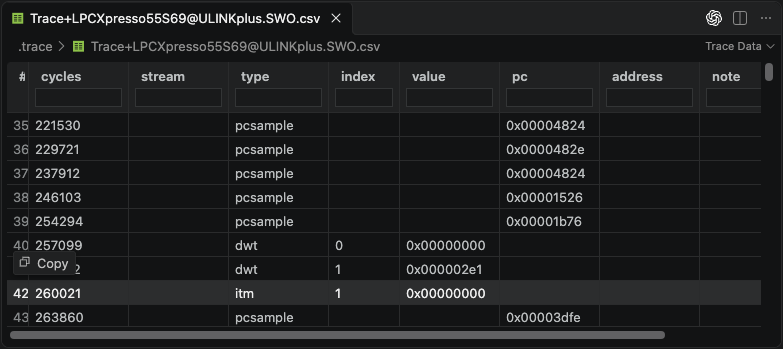
The trace viewer displays the decoded trace records in a table and supports filtering, sorting, keyboard and mouse navigation, selecting records, and copying trace data.
Use the column controls to sort the trace. Successive selections cycle through ascending, descending, and the original trace order.
Use filtering to locate specific records or values within the captured trace.
The meaning of index and value depends on the trace source that generated the record:
- For DWT data trace, value contains the value captured when the configured memory location was accessed.
- For exception trace, index identifies the exception number and value identifies the corresponding exception event.
Timestamp information is incorporated into the cycle information rather than being displayed as separate timestamp records.
Locate the source of a trace record
You can correlate a captured trace record with the configuration that generated it.
Hold Ctrl/⌘ and select a trace record in the CSV viewer. CMSIS Debugger highlights the corresponding configuration in the Trace Generation view.
For example, selecting a DWT data trace record identifies the DWT data trace point that generated the record.
Change trace settings during debugging
You can modify trace source settings while a debug session is active.
Changes that have not yet been saved are indicated in the Trace Generation view. The view also indicates unsaved changes when the affected configuration section is collapsed.
Press to store the updated configuration.
The new configuration is used once execution is resumed.
Handle trace overflow
An overflow record indicates that trace information was lost because the generated trace exceeded the available trace bandwidth.
When overflow occurs, consider reducing the amount of enabled trace information or adjusting the trace configuration to reduce bandwidth consumption. For example, changing timestamp or ITM-related settings can reduce the amount of generated trace data.
📝 Note:
A capture file containing overflow records indicates gaps in the trace. Take this into account when analyzing the captured data.
Consider hardware resource limitations
Cortex-M trace functionality uses hardware resources that vary between processors. The number and capabilities of DWT comparators, trace sources, and supported trace combinations therefore depend on the selected target.
In particular, DWT data trace shares comparator resources with data access breakpoints. Advanced data trace configurations, such as value-dependent trace points, can consume additional hardware resources.
CMSIS Debugger validates the configuration and reports combinations that are not supported by the selected processor.
When configuring several trace sources, enable only the information required for the current investigation. This preserves both target trace resources and available SWO bandwidth.
📝 Note:
Trace-related DWT configuration is performed before GDB configures data access breakpoints. As a result, DWT resources allocated for trace may prevent GDB from setting previously functional data access breakpoints.
Note that GDB installs data access breakpoints immediately before execution resumes and removes them when execution stops.
Debug adapter support
Keil Studio support various debug adapters and and GDB server implementations from different vendors:
- Most of the debug adapters (including ST-Link) are served by pyOCD using the Arm CMSIS Debugger extension.
- Segger J-Link Server is supported.
- Arm Debugger is supported.
- Running on Arm FVPs is possible.
- Arm Keil µVision is supported (only on Windows).
If you are using a third-party debug adapter, make sure that the latest drivers are installed on your machine and that
the debug adapters are running the latest firmware. Set the PATH variable correctly.
| Debug Adapter | Notes |
|---|---|
| Arm ULINKplus | Make sure that the V2.x.x firmware is installed. |
| Arm ULINK2 | Make sure that the voltage jumper is set correctly. Select CMSIS-DAP@pyOCD as the debug adapter. |
| Infineon KitProg3 | Make sure that the latest firmware is installed. |
| Microchip PICKit Basic | Use the Python utility pycmsisdapswitcher to switch the firmware to a CMSIS-DAP v2 implementation. |
| Nuvoton NuLink | Make sure that the latest firmware is installed. |
| NXP MCU-Link | Make sure that the latest firmware is installed. |
| Raspberry Pi Debugprobe | Make sure that the latest firmware is installed. |
| SEGGER J-Link | For J-Link support, visit J-Link/J-Trace Downloads. Set the PATH variable to the bin directory of the installation. |
| STMicroelectronics ST-Link | For ST-LINK/V2 and ST-LINK/V2-1 support on Windows, download the USB driver here: STSW-LINK009. |
Select debug adapter
In the CMSIS view, open the Manage Solution dialog and go to the Debug Adapter section. Select one of the debug adapters. Once selected, the following JSON files are created automatically:
- In the
launch.jsonfile,attachandlaunchconfigurations are added that let you attach the debug adapter to an already running GDB instance (for example when you have issued aload and runbefore) or launch a new debug session. - In the
tasks.jsonfile, the tasksCMSIS Erase,CMSIS Load, andCMSIS Runare created.
Note
If you wish to preserve manual modification to the JSON files, uncheck "Update launch.json and tasks.json" in the Debug Adapter for ... section.
Set debug adapter ID
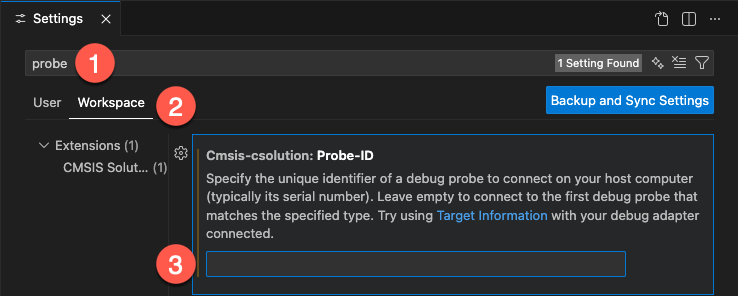
In case you have multiple debug adapters connected to your computer, you can set the ID of the probe you wish to use in the CMSIS Solution extension settings.
Open the settings by pressing CTRL/CMD + ,.
- Enter
probein the search field. - Select if you want to set the probe ID for your user or only for the current workspace (recommended).
- Enter the
Unique IDyou have retrieved using Target Information.
Configure run and debug
In VS Code, you can integrate external tools via a tasks.json file. The debug configuration is managed via the
launch.json file. Both files are generated automatically based on your *.csolution.yml file:
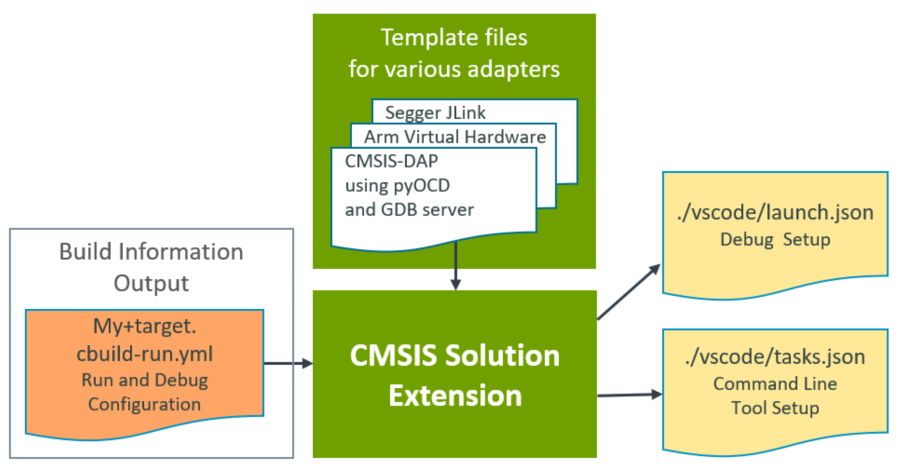
When creating a Target Set in the Manage Solution view and selecting a
Debug Adapter, the information is stored in the target-set: node in the *.csolution.yml file (refer to the
CMSIS-Toolbox user's guide for
details on target-set).
When you save the target set, the CMSIS Solution extension calls cbuild setup that generates the
*.cbuild-run.yml file which contains the run and debug description of your solution. Using template files for the
various debug adapters from the Debug Adapter Registry and
taking the user inputs into account, the CMSIS Solution extension then generates the launch.json and tasks.json
files.
Custom launch.json and tasks.json settings
Generation pipeline
The CMSIS Solution extension creates the workspace .vscode/launch.json and .vscode/tasks.json files from
several sources:
target-set in *.csolution.yml
  -> cbuild setup
  -> *.cbuild-run.yml
  -> debug adapter template expansion
  -> workspace .vscode/launch.json and .vscode/tasks.json
  -> final merge of solution-local .vscode.d drop-in files
The target-set: information is stored in the *.csolution.yml file. Running cbuild setup generates the
*.cbuild-run.yml file, and the debug adapter templates use that information to create the auto-generated workspace
entries.
Note
To trigger an update of the launch.json and tasks.json files, press Ctrl/Cmd+Shift+p and select
Update Debug Tasks and Launch Configurations.
Direct edits in .vscode
User defined launch configurations and tasks can be added directly into the workspace files. When updating these files, custom or modified entries are kept untouched if detected:
.vscode/launch.jsonEach auto-generated configuration has an additional propertycmsis.updateConfiguration="auto". By either removing this property, or by setting it tomanual, the configuration is excluded from further automatic updates..vscode/tasks.jsonAll auto-generated tasks have labels starting withCMSIS. Such tasks are removed on updates. Custom tasks must use names not starting withCMSIS.
.vscode.d drop-ins
Instead of placing custom content into the automatically updated workspace files, you can keep solution-specific
overrides in configuration subfolders parallel to the .csolution.yml file they belong to and keep only those files
under version control.
Example workspace layout with two solutions:
<workspace>/
  .vscode/
    launch.json
    tasks.json
  Blinky/
    blinky.csolution.yml
    .vscode.d/
      launch.json
      tasks.json
  Sensor/
    sensor.csolution.yml
    .vscode.d/
      launch.json
      tasks.json
The extension consumes only the following content from the drop-in files:
<solution dir>/.vscode.d/launch.jsonTheconfigurationsarray. Configurations are matched and merged by thenameproperty.<solution dir>/.vscode.d/tasks.jsonThetasksandinputsarrays. Tasks are matched and merged bylabel, and inputs are matched and merged byid.
The .vscode.d files do not replace the whole workspace .vscode/launch.json or .vscode/tasks.json files. They
only overwrite matching entries during the final merge step. Non-matching workspace entries remain untouched.
Example launch.json drop-in:
{
  "configurations": [
    {
      "name": "CMSIS Debug (MCXN947)",
      "runToEntryPoint": "main"
    },
    {
      "name": "My Custom Attach",
      "type": "cortex-debug",
      "request": "attach"
    }
  ]
}
In this example, the existing CMSIS Debug (MCXN947) configuration is overwritten because the name matches, while
My Custom Attach is added as an additional configuration.
Example tasks.json drop-in:
{
  "tasks": [
    {
      "label": "CMSIS Load",
      "dependsOn": [
        "My Pre-Load Step"
      ]
    },
    {
      "label": "My Pre-Load Step",
      "type": "shell",
      "command": "echo preparing target"
    }
  ],
  "inputs": [
    {
      "id": "cmsis-image",
      "type": "pickString",
      "description": "Select image"
    },
    {
      "id": "my-extra-input",
      "type": "promptString",
      "description": "Extra argument"
    }
  ]
}
In this example, CMSIS Load is overwritten because the label matches, My Pre-Load Step is added as a new task,
cmsis-image is overwritten because the id matches, and my-extra-input is added as a new input.
Merge precedence
The workspace launch.json and tasks.json files are updated in the following order:
- Auto-generated configurations and tasks are added or updated for the selected debug probe using the generated
*.cbuild-run.ymlcontent and the debug adapter templates. - Outdated formerly auto-generated configurations and tasks are removed.
- Configurations, tasks, and inputs from the solution-local
.vscode.dfiles are merged into the workspace files. Existing elements are overwritten only when the respective identification properties match:namefor launch configurations,labelfor tasks, andidfor inputs.
pyOCD
In the Manage Solution dialog, select the one of the debug adapters named xyz@pyOCD:
For the Debug Interface, you can:
- Set the maximum clock speed.
- Select the debug protocol (
SWDorJTAG).
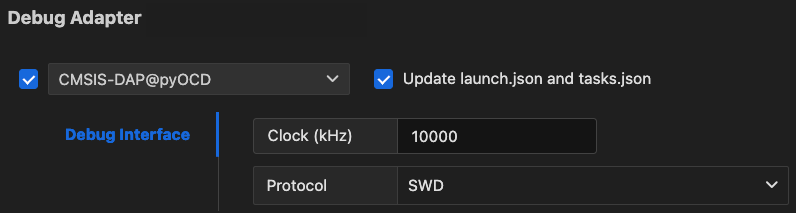
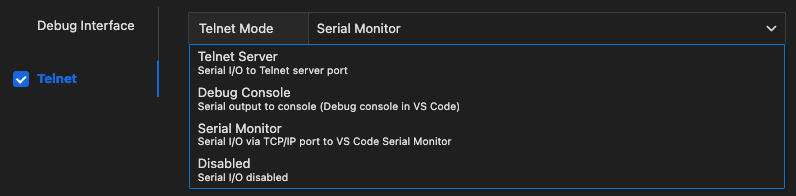
For Telnet, you can:
- Enable or disable the use of Telnet for semihosting.
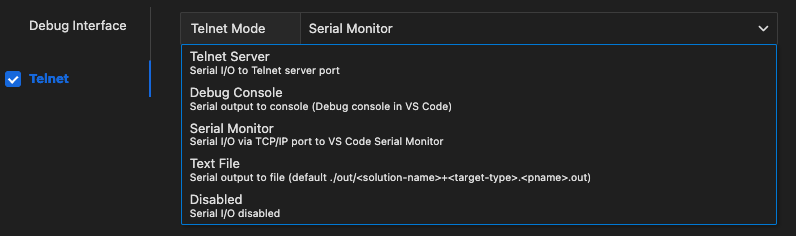
- Set the Telnet Mode to:
- Telnet Server: if you want to connect to the target with a standalone Telnet Client application.
- Debug Console: redirects the output to the VS Code DEBUG CONSOLE panel.
- Serial Monitor: redirects the output to the SERIAL MONITOR extension.
- Text File: saves the output to a file in the project workspace.
- Disabled: does not redirect the serial output.
J-Link Server
In the Manage Solution dialog select J-Link Server.
For the Debug Interface, you can:
- Set the maximum clock speed.
- Select the debug protocol (
SWDorJTAG).

For Telnet, you can:
- Enable or disable the use of Telnet for semihosting.
- Set the Telnet Mode to:
- Telnet Server: if you want to connect to the target with a standalone Telnet Client application.
- Debug Console: redirects the output to the VS Code DEBUG CONSOLE panel.
- Serial Monitor: redirects the output to the SERIAL MONITOR extension.
- Disabled: does not redirect the serial output.
Arm Debugger
You can use the Arm Debugger with Keil Studio.
Prerequisites
Before you can launch a debug session using Arm Debugger, you need to:
- Install the Arm Debugger VS Code extension.
- Add the Arm Debugger to your
vcpkg-configuration.jsonfile, for example:
"arm:debuggers/arm/armdbg": "6.6.0"
Setup for Arm Debugger
In the Manage Solution dialog, select the one of the debug adapters named xyz@Arm-Debugger.

Arm FVPs
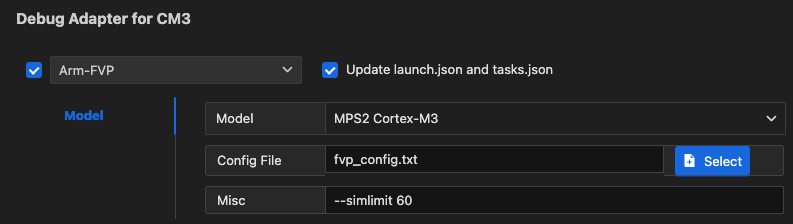
In the Manage Solution dialog:
- Select the Arm-FVP debug adapter
- Select the model you wish to use
- Point to your configuration file
- If you wish to set a simulation limit, add this in the Misc box:
Keil uVision
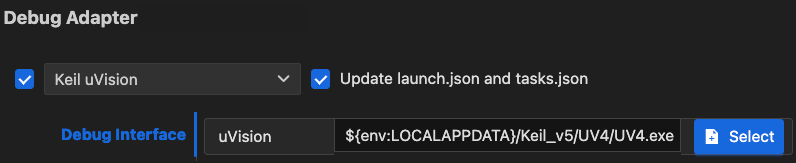
In the Manage Solution dialog:
- Select the Keil uVision debug adapter.
- Set the path to the
UV4.exefile (the default is%LOCALAPPDATA%\Keil_v5\UV4\UV4.exe). - This setting is saved in the
*.csolution.ymlfile.
Attention
This only works on a Windows PC.
Changing the default for the current workspace
If you wish to change the default path to µVision for your current workspace, you need to create the following entry
in your .vscode/settings.json file:
{
    "cmsis-csolution.debug-adapters": {
        "Keil uVision": {
            "uv4": "/path/to/UV4.exe"
        }
    }
}
Attention
If you use "Initialize Git repository" when creating a csolution, this file is ignored by default.
Changing the default for a user
If you wish to set the µVision path for your user, open the global settings.json file:
- Press Ctrl/Cmd + Shift + p and type
settings. - Select Preferences: Open User Settings (JSON). This opens the global
settings.jsonfile. - Enter the path as shown above and save the file.
Enhancing the debug experience
To ensure the best debug experience with Arm Compiler for Embedded, make sure that your CMSIS solution files contain the following.
csolution.yml
In the *.csolution.yml file, insert the following block in - target-types\- type section:
      target-set:
        - set:
          debugger:
            name: # set to name of your debug adapter
Insert the following before the - projects section:
  misc:
   - for-compiler: AC6
     C-CPP:
       - -gdwarf-5
     ASM:
       - -gdwarf-5
cproject.yml
In the *.cproject.yml file, add at the end:
  output:
    type:
     - elf
     - hex
     - map